 E-mail alert
 Rss
Rss



A state-of-the-art Fuzzy Nonlinear Additive Regression (FNAR) model for groundwater level prediction
-
Abstract: Groundwater modeling remains challenging due to heterogeneity and complexity of aquifer systems, necessitating endeavors to quantify Groundwater Levels (GWL) dynamics to inform policymakers and hydrogeologists. This study introduces a novel Fuzzy Nonlinear Additive Regression (FNAR) model to predict monthly GWL in an unconfined aquifer in eastern Iran, using a 19-year (1998–2017) dataset from 11 piezometric wells. Under three distinct scenarios with progressively increasing input complexity, the study utilized readily available climate data, including Precipitation (Prc), Temperature (Tave), Relative Humidity (RH), and Evapotranspiration (ETo). The dataset was split into training (70%) and validation (30%) subsets. Results showed that among three input scenarios, Scenario 3 (Sc3, incorporating all four variables) achieved the best predictive performance, with RMSE ranging from 0.305 m to 0.768 m, MAE from 0.203 m to 0.522 m, NSE from 0.661 to 0.980, and PBIAS from 0.771% to 0.981%, indicating low bias and high reliability. However, Sc2 (excluding ETo) with RMSE ranging from 0.4226 m to 0.9909 m, MAE from 0.3418 m to 0.8173 m, NSE from 0.2831 to 0.9674, and PBIAS from −0.598% to 0.968% across different months offers practical advantages in data-scarce settings. The FNAR model outperforms conventional Fuzzy Least Squares Regression (FLSR) and holds promise for GWL forecasting in data-scarce regions where physical or numerical models are impractical. Future research should focus on integrating FNAR with deep learning algorithms and real-time data assimilation expanding applications across diverse hydrogeological settings.
-

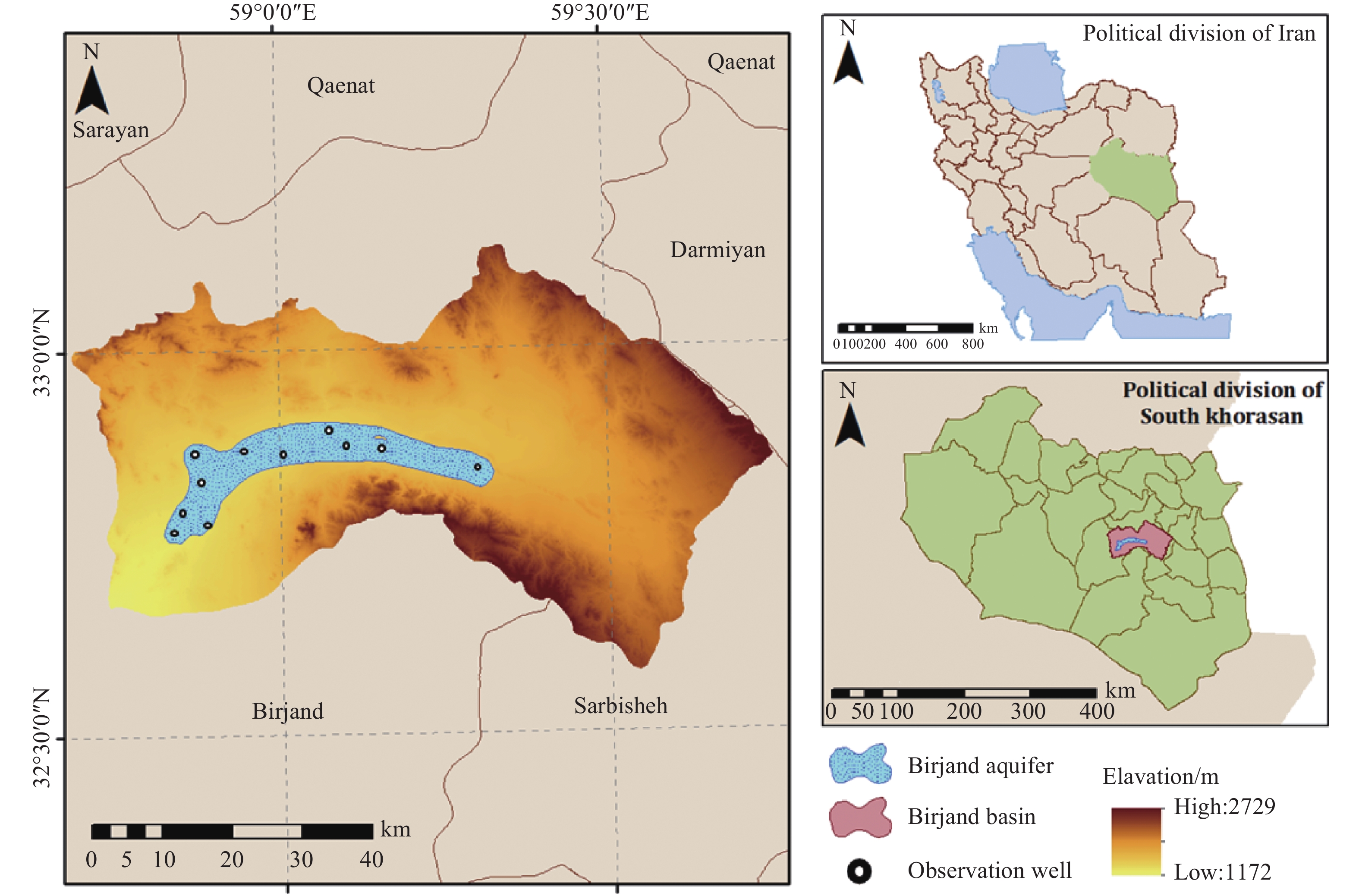
Figure 1. Geographic and topographic context of the Birjand aquifer study area
Notes: Location of South Khorasan Province within Iran (Top right); Political divisions of South Khorasan with Birjand Basin highlighted in pink (Bottom right); Digital elevation model (DEM) of the Birjand basin (elevation range: 1,172–2,729 m above sea level), with the unconfined aquifer extent shown in blue (Main panel). Coordinate system: WGS84/UTM Zone 40N. Scale bar and north arrow included for spatial reference.

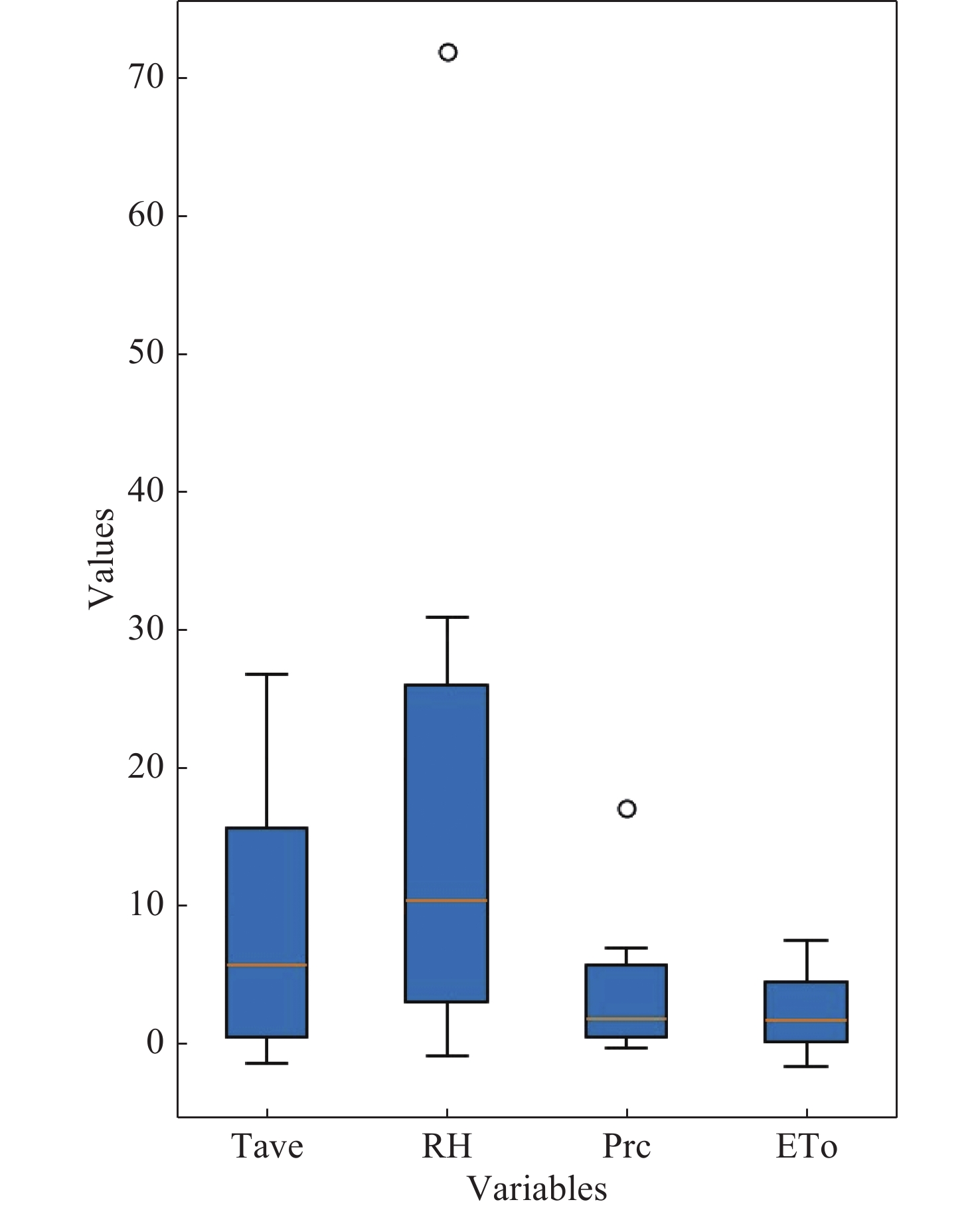
Figure 2. Boxplot of monthly meteorological variables (Tave, RH, Prc, ETo) at Birjand station.

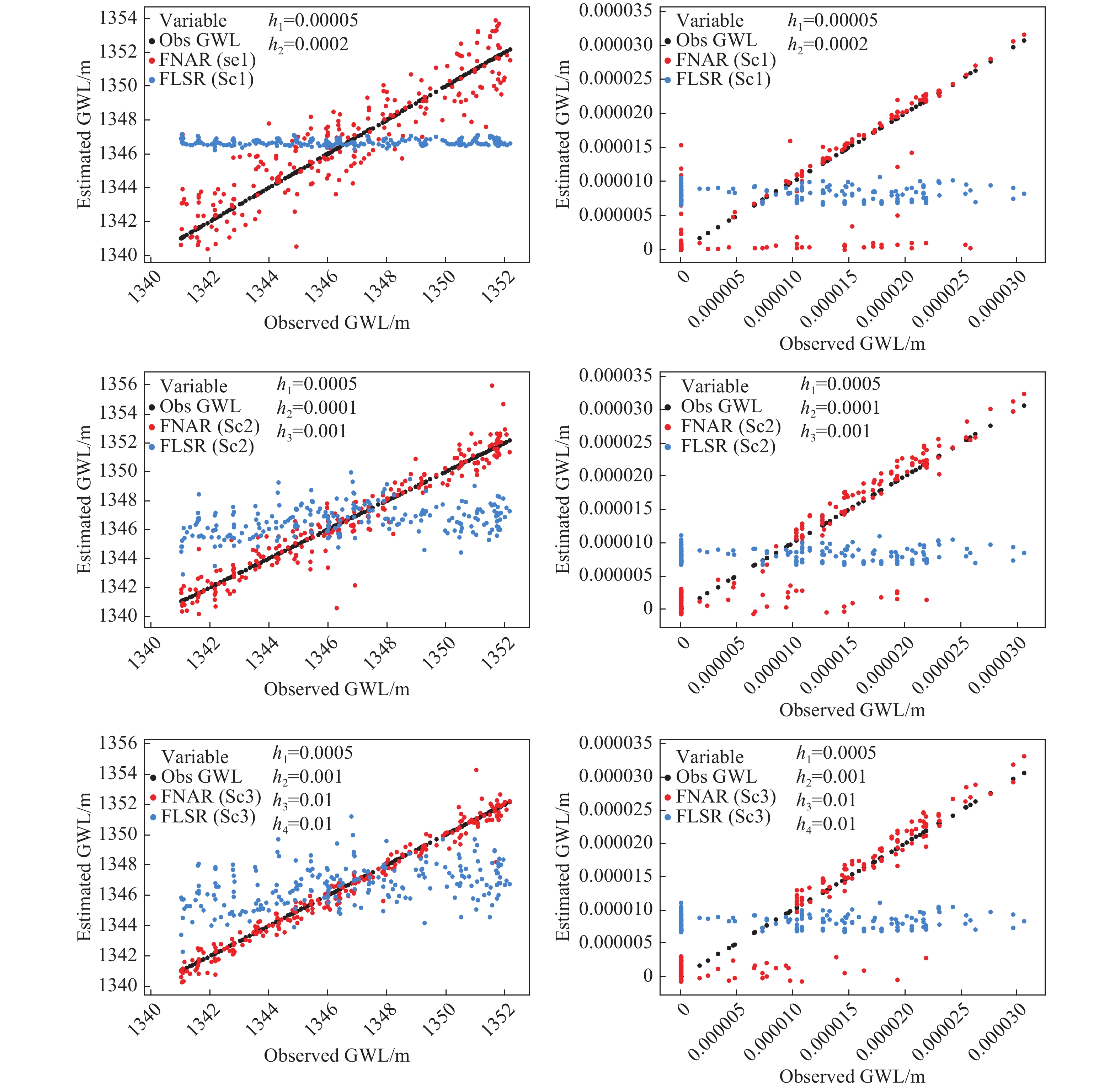
Figure 4. Comparative analysis of monthly GWL values performance of FNAR and FLSR models
Table 1. Input parameter combinations for GWL estimation in model scenarios of the Birjand Plain
Scenario number Climatic parameters Sc 1 Prc, Tave Sc 2 Prc, Tave RH Sc 3 Prc, Tave RH, ETo Notes: This table provides an overview of the input variables employed in the model scenarios for GWL estimation. These variables include key climatic factors such as average precipitation (Prc), mean air temperature (Tave), relative humidity (RH), and evapotranspiration (ETo).  下载: 导出CSV
Table 2. Validation indices for FNAR model performance in monthly GWL estimation under different scenarios
Model/Sc Month Training Testing RMSE (m) MAE NSE RMSE (m) MAE NSE FNAR/Sc1 January 1.115 0.879 0.761 1.051 0.531 0.762 February 1.181 0.955 0.738 1.124 0.901 0.831 March 1.310 1.074 0.665 1.361 1.101 0.710 April 1.150 0.653 0.813 1.061 0.403 0.806 May 1.545 1.103 0.316 1.525 0.998 0.325 June 1.195 0.649 0.730 1.159 0.488 0.780 July 1.182 0.633 0.737 1.061 0.403 0.806 August 1.312 0.741 0.629 1.356 0.757 0.611 September 1.236 1.059 0.692 1.265 1.073 0.694 October 1.406 0.912 0.473 1.470 0.831 0.400 November 1.449 1.259 0.614 1.421 1.124 0.656 December 1.205 0.793 0.620 1.323 0.738 0.617 FNAR/Sc2 January 0.423 0.353 0.966 0.433 0.342 0.806 February 0.549 0.415 0.943 0.553 0.509 0.774 March 0.564 0.451 0.937 0.576 0.486 0.910 April 0.540 0.445 0.943 0.490 0.450 0.809 May 0.941 0.794 0.826 0.991 0.817 0.841 June 0.650 0.527 0.919 0.588 0.499 0.729 July 0.985 0.740 0.721 0.769 0.535 0.522 August 0.934 0.673 0.836 0.433 0.342 0.806 September 0.813 0.793 0.493 0.618 0.529 0.702 October 0.683 0.596 0.914 0.952 0.670 0.283 November 0.926 0.705 0.742 0.825 0.803 0.470 December 0.682 0.390 0.967 0.800 0.612 0.519 FNAR/Sc3 January 0.324 0.248 0.980 0.305 0.258 0.926 February 0.400 0.324 0.969 0.337 0.203 0.910 March 0.457 0.402 0.821 0.586 0.522 0.719 April 0.392 0.285 0.970 0.312 0.331 0.927 May 0.768 0.291 0.872 0.600 0.272 0.709 June 0.428 0.390 0.964 0.646 0.413 0.661 July 0.526 0.450 0.948 0.488 0.368 0.815 August 0.511 0.434 0.931 0.497 0.409 0.810 September 0.585 0.519 0.936 0.466 0.390 0.831 October 0.555 0.431 0.943 0.510 0.330 0.794 November 0.460 0.349 0.957 0.310 0.333 0.925 December 0.549 0.415 0.943 0.305 0.258 0.926
下载: 导出CSV
Table 3. Validation indices for FLSR model performance in monthly GWL estimation under different scenarios
Regression Model/Sc Month Training Testing RMSE/m MAE/m NSE RMSE/m MAE/m NSE FLSR/Sc1 January 2.679 2.142 −0.353 3.632 3.402 −1.890 February 2.568 2.083 −0.413 3.528 3.357 −1.841 March 2.674 2.157 −0.371 3.524 3.301 −1.799 April 2.703 2.175 −0.384 3.560 3.393 −1.530 May 3.113 2.484 −0.901 3.650 3.377 −1.450 June 3.123 2.438 −0.845 3.701 3.523 −1.766 July 3.130 2.483 −0.841 3.939 3.943 −2.112 August 3.046 2.426 −0.736 3.917 3.733 −2.042 September 3.194 2.832 −0.966 3.823 3.775 −2.131 October 2.891 2.339 −0.522 3.810 3.723 −2.086 November 2.770 2.250 −0.408 3.665 3.487 −1.409 December 3.079 2.459 −0.382 3.761 3.587 −1.990 FLSR/Sc2 January 2.224 1.846 0.051 2.127 2.724 −1.489 February 2.667 2.177 −0.331 2.979 2.836 −1.842 March 3.507 2.775 −1.394 2.750 2.301 −1.373 April 2.638 2.237 −0.308 3.013 1.725 −1.610 May 3.276 2.642 −1.105 2.853 2.625 −1.449 June 3.126 2.539 −0.848 3.032 2.917 −1.615 July 2.827 2.258 −0.513 3.204 3.041 −1.954 August 3.330 2.663 −1.232 2.861 2.799 −1.540 September 3.024 2.376 −0.633 3.406 3.587 −1.712 October 3.139 2.546 −0.795 2.924 2.757 −1.647 November 2.874 2.429 −0.408 2.861 2.799 −1.540 December 2.741 2.272 −0.416 2.914 2.796 −1.766 FLSR/Sc3 January 2.296 1.229 −0.215 2.343 1.516 −0.322 February 2.308 1.219 −0.103 2.350 1.372 −0.240 March 2.340 1.121 0.002 2.609 2.279 −1.028 April 2.321 1.272 0.007 2.611 1.399 −1.019 May 3.244 2.115 −1.065 3.770 2.543 −1.244 June 3.356 2.430 −1.129 3.843 2.716 −1.400 July 2.554 1.352 −0.226 2.301 1.279 −0.288 August 2.798 1.566 −0.071 2.415 1.600 −0.139 September 2.941 1.682 −0.638 2.865 1.503 −1.050 October 3.094 2.131 −0.926 3.722 2.453 −1.132 November 3.781 2.109 −1.784 3.921 2.742 −1.521 December 2.542 1.440 −0.518 2.890 1.600 −1.142
下载: 导出CSV
Table 4. Validation indices for FLSR model performance in monthly GWL estimation under different Scenarios
Model/Sc Month Training Testing RMSE (m) MAE (m) NSE KGE PBIAS (%) RMSE (m) MAE (m) NSE KGE PBIAS (%) FLSR/Sc1 January 2.679 2.142 −0.353 −0.312 9.215 3.632 3.402 −1.890 −1.650 15.32 February 2.568 2.083 −0.413 −0.372 9.512 3.528 3.357 −1.841 −1.610 15.84 March 2.674 2.157 −0.371 −0.330 9.318 3.524 3.301 −1.799 −1.572 15.11 April 2.703 2.175 −0.384 −0.343 9.412 3.560 3.393 −1.530 −1.312 13.95 May 3.113 2.484 −0.901 −0.861 12.32 3.650 3.377 −1.450 −1.210 14.52 June 3.123 2.438 −0.845 −0.805 11.89 3.701 3.523 −1.766 −1.532 15.67 July 3.130 2.483 −0.841 −0.801 11.85 3.939 3.943 −2.112 −1.872 18.24 August 3.046 2.426 −0.736 −0.696 11.21 3.917 3.733 −2.042 −1.802 17.67 September 3.194 2.832 −0.966 −0.926 12.85 3.823 3.775 −2.131 −1.891 18.43 October 2.891 2.339 −0.522 −0.482 10.15 3.810 3.723 −2.086 −1.846 17.97 November 2.770 2.250 −0.408 −0.367 9.472 3.665 3.487 −1.409 −1.178 13.45 December 3.079 2.459 −0.382 −0.341 9.392 3.761 3.587 −1.990 −1.750 16.32 FLSR/Sc2 January 2.224 1.846 0.051 0.089 5.123 2.127 2.724 −1.489 −1.212 10.45 February 2.667 2.177 −0.331 −0.293 8.156 2.979 2.836 −1.842 −1.598 12.67 March 3.507 2.775 −1.394 −1.354 14.67 2.750 2.301 −1.373 −1.132 10.15 April 2.638 2.237 −0.308 −0.270 7.956 3.013 1.725 −1.610 −1.372 11.32 May 3.276 2.642 −1.105 −1.065 12.32 2.853 2.625 −1.449 −1.208 10.86 June 3.126 2.539 −0.848 −0.808 11.21 3.032 2.917 −1.615 −1.374 11.45 July 2.827 2.258 −0.513 −0.473 9.856 3.204 3.041 −1.954 −1.712 13.45 August 3.330 2.663 −1.232 −1.192 13.45 2.861 2.799 −1.540 −1.298 10.67 September 3.024 2.376 −0.633 −0.593 10.46 3.406 3.587 −1.712 −1.470 12.15 October 3.139 2.546 −0.795 −0.755 10.85 2.924 2.757 −1.647 −1.405 11.67 November 2.874 2.429 −0.408 −0.368 9.156 2.861 2.799 −1.540 −1.298 10.67 December 2.741 2.272 −0.416 −0.376 9.256 2.914 2.796 −1.766 −1.524 12.32 FLSR/Sc3 January 2.296 1.229 −0.215 −0.178 3.215 2.343 1.516 −0.322 −0.280 4.320 February 2.308 1.219 −0.103 −0.068 2.856 2.350 1.372 −0.240 −0.202 3.972 March 2.340 1.121 0.002 0.038 2.156 2.609 2.279 −1.028 −0.788 8.456 April 2.321 1.272 0.007 0.043 2.312 2.611 1.399 −1.019 −0.779 8.320 May 3.244 2.115 −1.065 −1.025 8.856 3.770 2.543 −1.244 −1.004 9.672 June 3.356 2.430 −1.129 −1.089 9.320 3.843 2.716 −1.400 −1.160 10.46 July 2.554 1.352 −0.226 −0.188 3.456 2.301 1.279 −0.288 −0.248 4.120 August 2.798 1.566 −0.071 −0.035 2.712 2.415 1.600 −0.139 −0.103 3.456 September 2.941 1.682 −0.638 −0.598 6.156 2.865 1.503 −1.050 −0.810 8.672 October 3.094 2.131 −0.926 −0.886 7.856 3.722 2.453 −1.132 −0.892 9.320 November 3.781 2.109 −1.784 −1.744 12.46 3.921 2.742 −1.521 −1.281 10.97 December 2.542 1.440 −0.518 −0.478 5.856 2.890 1.600 −1.142 −0.902 9.120
下载: 导出CSV
-
Adnan RM, Dai HL, Mostafa RR, et al. 2023. Modelling groundwater level fluctuations by ELM merged advanced metaheuristic algorithms using hydroclimatic data. Geocarto International, 38(1): 2158951. DOI: 10.1080/10106049.2022.2158951. Ahmadi A, Olyaei M, Heydari Z, et al. 2022. Groundwater level modeling with machine learning: A systematic review and meta-analysis. Water, 14(6): 949. DOI: 10.3390/w14060949. Ahmadifar R, Safavi HR, Mirabbasi R, et al. 2025. A hybrid vine copula-fuzzy model for groundwater level simulation under uncertainty. Environmental Monitoring and Assessment, 197(4): 403. DOI: 10.1007/s10661-025-13856-3. Ang YK, Talei A, Zahidi I, et al. 2023. Past, present, and future of using neuro-fuzzy systems for hydrological modeling and forecasting. Hydrology, 10(2): 36. DOI: 10.3390/hydrology10020036. Aryafar A, Khosravi V, Karami, S. 2020. Groundwater quality assessment of Birjand plain aquifer using kriging estimation and sequential Gaussian simulation methods. Environmental Earth Sciences, 79: 1−21. DOI: 10.1007/s12665-020-08905-8. Asadolahi M, Akbari MG, Hesamian G, et al. 2021. A robust support vector regression with exact predictors and fuzzy responses. International Journal of Approximate Reasoning, 132: 206−225. DOI: 10.1016/j.ijar.2021.02.006. Bardossy A, Duckstein L. 2022. Fuzzy rule-based modeling with applications to geophysical, biological, and engineering systems. CRC Press, London, United Kingdom. DOI: 10.1201/9780138755133 Bhadani V, Singh A, Kumar, V, et al. 2024. Nature-inspired optimal tuning of input membership functions of a fuzzy inference system for groundwater level prediction. Environmental Modelling and Software, 175: 105995. DOI: 10.1016/j.envsoft.2024.105995. Bogardi I, Bardossy A, Duckstein L. 1983. Regional management of an aquifer for mining under fuzzy environmental objectives. Water Resources Research, 19(6): 1394−1402. DOI: 10.1029/WR019i006p01394. Boo KBW, El-Shafie A, Othman F, et al. 2024. Groundwater level forecasting using ensemble coactive neuro-fuzzy inference system. Science of The Total Environment, 912: 168760. DOI: 10.1016/j.scitotenv.2023.168760. Borzì I. 2025. Modeling groundwater resources in data-scarce regions for sustainable management: Methodologies and limits. Hydrology, 12(1): 2306−5338. DOI: 10.3390/hydrology12010011. Condon LE, Kollet S, Bierkens MF, et al. 2021. Global groundwater modeling and monitoring: Opportunities and challenges. Water Resources Research, 57(12): e2020WR029500. DOI: 10.1029/2020WR029500. Feng F, Ghorbani H, Radwan AE. 2024. Predicting groundwater level using traditional and deep machine learning algorithms. Frontiers in Environmental Science, 12: 1291327. DOI: 10.3389/fenvs.2024.1291327. Hoogesteger J. 2022. Regulating agricultural groundwater use in arid and semi-arid regions of the Global South: Challenges and socio-environmental impacts. Current Opinion in Environmental Science and Health, 100341. DOI: 10.1016/j.coesh.2022.100341 Hu H, Yang K, Sharma A, et al. 2020. Assessment of water and energy scarcity, security and sustainability into the future for the Three Gorges Reservoir using an ensemble of RCMs. Journal of Hydrology, 586: 124893. DOI: 10.1016/j.jhydrol.2020.124893. Kambalimath S, Deka PC. 2020. A basic review of fuzzy logic applications in hydrology and water resources. Applied Water Science, 10(8): 1−14. DOI: 10.1007/s13201-020-01276-2. Koonce JE. 2016. Water balance and moisture dynamics of an arid and semi-arid soil: A weighing lysimeter and field study. DOI: 10.34917/9112095 Kuang X, Liu J, Scanlon BR, et al. 2024. The changing nature of groundwater in the global water cycle. Science, 383(6686): eadf0630. DOI: 10.1126/science.adf0630. Lall U, Josset L, Russo T. 2020. A snapshot of the world's groundwater challenges. Annual Review of Environment and Resources, 45(1): 171−194. DOI: 10.1146/annurev-environ-102017-025800. Loucks DP. 2023. Hydroinformatics: A review and future outlook. Cambridge Prisms: Water, 1: e10. DOI: 10.1017/wat.2023.10. Malakar P, Bhanja SN, Dash AA, et al. 2022. Delineating variabilities of groundwater level prediction across the agriculturally intensive transboundary aquifers of South Asia. ACS ES& T Water, 3(6): 1547−1560. DOI: 10.1021/acsestwater. 2c00220. Moges E, Demissie Y, Larsen L, et al. 2021. Sources of hydrological model uncertainties and advances in their analysis. Water, 13(1): 28. DOI: 10.3390/w13010028. NavaleV, Mhaske S. 2023. Artificial neural network (ANN) and adaptive neuro-fuzzy inference system (ANFIS) model for Forecasting groundwater level in the Pravara River Basin, India. Modeling Earth Systems and Environment, 9(2): 2663−2676. DOI: 10.1007/s40808-022-01639-5. Rahimi M, Ebrahimi H. 2023. Data-driven driven to underground water level using artificial intelligence hybrid algorithms. Scientific Reports, 13(1): 10359. DOI: 10.1038/s41598-023-35255-9. Ramezani N. 2022. Modern statistical modeling in machine learning and big data analytics: Statistical models for continuous and categorical variables. In research anthology on machine learning techniques, methods, and applications (pp. 90−106). IGI Global. DOI: 10.4018/978-1-6684-6291-1.ch007. Rashidi GH, Katibeh H, Maleki A. 2024. Forecasting groundwater fluctuations caused by earthquakes using fuzzy logic and AHP Method: A case study from Iran. Earth Science Informatics, 17(3): 2143−2158. DOI: 10.1007/s12145-024-01264-z. Saikrishnamacharyulu I, Mohanta NR, Kumar MH, et al. 2022. Simulation of water table depth using a hybrid CANFIS model: A Case study. In Intelligent System Design: Proceedings of INDIA 2022 (pp. 319−328). Singapore: Springer Nature Singapore. DOI: 10.1007/978-981-19-4863-3_30. Samani S, Vadiati M, Azizi F, et al. 2022. Groundwater level simulation using soft computing methods with emphasis on major meteorological components. Water Resources Management, 36(10): 3627−3647. DOI: 10.1007/s11269-022-03217-x. Samantaray S, Biswakalyani C, Singh DK, et al. 2022. Prediction of groundwater fluctuation based on a hybrid ANFIS-GWO approach in an arid Watershed, India. Soft Computing, 26(11): 5251−5273. DOI: 10.1007/s00500-022-07097-6. Samantaray S, Sahoo A, Baliarsingh F. 2024. Groundwater level prediction using an improved SVR model integrated with hybrid particle swarm optimization and firefly algorithm. Cleaner Water, 1: 100003. DOI: 10.1016/j.clwat.2024.100003. Sun J, Hu L, Li D, et al. 2022. Data-driven models for accurate groundwater level prediction and their practical significance in groundwater management. Journal of Hydrology, 608: 127630. DOI: 10.1016/j.jhydrol.2022.127630 Tao H, Hameed MM, Marhoon HA, et al. 2022. Groundwater level prediction using machine learning models: A comprehensive review. Neurocomputing, 489: 271−308. DOI: 10.1016/j.neucom.2022.03.014. Theodoridou PG, Varouchakis EA, Karatzas GP. 2017. Spatial analysis of groundwater levels using fuzzy logic and geostatistical tools. Journal of Hydrology, 555: 242−252. DOI: 10.1016/j.jhydrol.2017.10.027. Varouchakis EA, Theodoridou PG, Karatzas GP. 2019. Spatiotemporal geostatistical modeling of groundwater levels under a Bayesian framework using means of physical background. Journal of Hydrology, 575: 487−498. DOI: 10.1016/j.jhydrol.2019.05.055. Yang X, Zhang Z. 2022. A CNN-LSTM model based on a meta-learning algorithm to predict groundwater level in the middle and lower reaches of the Heihe River, China. Water, 14(15): 2377. DOI: 10.3390/w14152377. Zaresefat M, Derakhshani R. 2023. Revolutionizing groundwater management with hybrid AI models: A practical review. Water, 15(9): 1750. DOI: 10.3390/w15091750. Zarinmehr H, Tizro AT, Fryar AE, et al. 2022. Prediction of groundwater level variations based on gravity recovery and climate experiment (GRACE) satellite data and a time-series analysis: a case study in the Lake Urmia basin, Iran. Environmental Earth Sciences, 81(6): 180. DOI: 10.1007/s12665-022-10296-x. Zowam FJ, Milewski AM. 2024. Groundwater level prediction using machine learning and geostatistical interpolation models. Water, 16(19): 2771. DOI: 10.3390/w16192771. -

 点击查看大图
计量
- 文章访问数: 5758
- HTML全文浏览量: 2571
- PDF下载量: 168
- 被引次数: 0


