 E-mail alert
 Rss
Rss



Study on the strength deterioration characteristics and microscopic mechanisms of moraine soil under freeze-thaw cycles
-
Abstract: To investigate the strength degradation characteristics and microscopic damage mechanisms of moraine soil under hydro-thermo-mechanical coupling conditions, a series of X-ray Diffraction (XRD), standard triaxial testing, Scanning Electron Microscopy (SEM), and Nuclear Magnetic Resonance (NMR) experiments were conducted. The mechanical property degradation laws and evolution characteristics of the microscopic pore structure of moraine soil under Freeze-Thaw (F-T) conditions were revealed. After F-T cycles, the stress-strain curves of moraine soil showed a strain-softening trend. In the early stage of F-T cycles (0–5 cycles), the shear strength and elastic modulus exhibited damage rate of approximately 10.33% ± 0.8% and 16.60% ± 1.2%, respectively. In the later stage (10–20 cycles), the strength parameters fluctuated slightly and tended to stabilize. The number of F-T cycles was negatively exponentially correlated with cohesion, while showing only slight fluctuation in the internal friction angle, thereby extending the Mohr-Coulomb strength criterion for moraine soil under F-T cycles. The NMR experiments quantitatively characterized the evolution of the internal pore structure of moraine soil under F-T cycles. As the number of F-T cycles increased, fine and micro pores gradually expanded and merged due to the frost-heaving effect during the water-ice phase transition, forming larger pores. The proportion of large and medium pores increased to 59.55% ± 2.1% (N=20), while that of fine and micro pores decreased to 40.45% ± 2.1% (N=20). The evolution of pore structure characteristics was essentially completed in the later stage of F-T cycles (10–20 cycles). This study provides a theoretical foundation and technical support for major engineering construction and disaster prevention in the Qinghai-Xizang Plateau.
-

Figure 3. Microstructure and mineral composition of the moraine soil. (a) SEM image of the soil sample (N=0 cycles, magnification: 200×); (b) XRD diffraction pattern identifying the primary mineral constituents, including quartz (Q), albite (A), orthoclase (O), hornblende (H), and muscovite (M)

Figure 4. The stress-strain curve of moraine under F-T cycle (a. $ {\sigma _{\text{3}}} = $100 kpa, $ w = $10.7%, b. $ {\sigma _{\text{3}}} = $100 kpa, $ w = $14.1%, c. $ {\sigma _{\text{3}}} = $100 kpa, $ w = $18%, d. $ {\sigma _{\text{3}}} = $150 kpa, $ w = $10.7%, e. $ {\sigma _{\text{3}}} = $150 kpa, $ w = $14.1%, f. $ {\sigma _{\text{3}}} = $150 kpa, $ w = $18%, g. $ {\sigma _{\text{3}}} = $200 kpa, $ w = $10.7%, h. $ {\sigma _{\text{3}}} = $200 kpa, $ w = $14.1%, i. $ {\sigma _{\text{3}}} = $200 kpa, $ w = $18%)

Figure 5. The relationship between elastic modulus of moraine soil and number of F-T cycles (a. $ {\sigma _{\text{3}}} = $100 kpa, b. $ {\sigma _{\text{3}}} = $150 kpa, c. $ {\sigma _{\text{3}}} = $200 kpa, d. $ w = $10.7%, e. $ w = $14.1%, f. $ w = $18%)

Figure 6. The relationship between shear strength of moraine soil and number of F-T cycles (a. $ {\sigma _{\text{3}}} = $100 kpa, b. $ {\sigma _{\text{3}}} = $150 kpa, c. $ {\sigma _{\text{3}}} = $200 kpa, d. $ w = $10.7%, e. $ w = $14.1%, f. $ w = $18%)

Figure 9. The relationship curve between the number of F-T cycles and the angle of internal friction

Figure 10. The surface of relations between the number of F-T cycles and the cohesion force

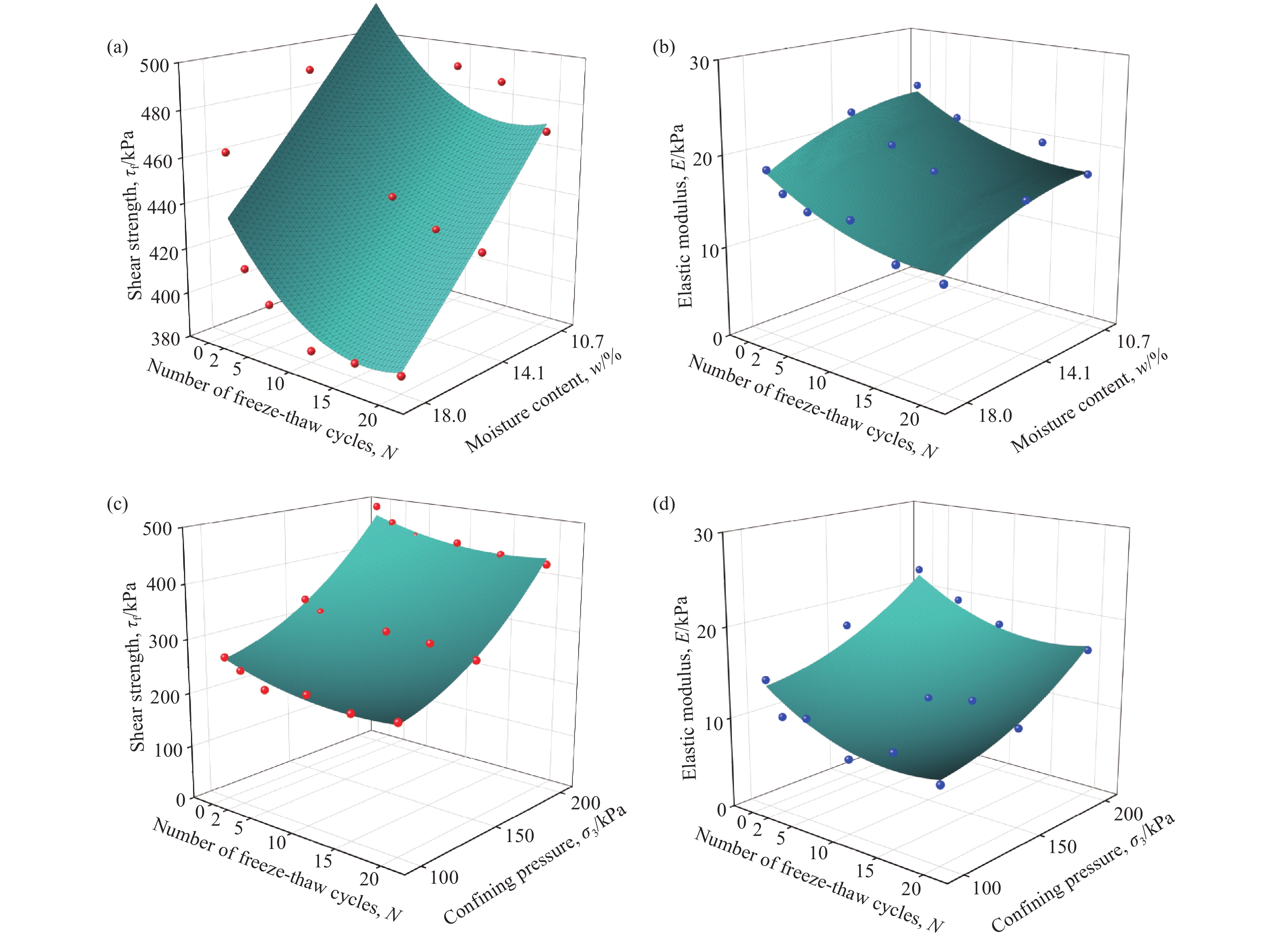
Figure 11. The multi-parameter coupling model for mechanical characteristics of moraine soil (a. the relationship surface among shear strength, number of F-T cycles and initial moisture content, b. the relationship surface among elastic modulus, the number of F-T cycles and initial moisture content, c. the relationship surface among shear strength, number of F-T cycles and confining pressure, d. the relationship surface among elastic modulus, number of F-T cycles and confining pressure)

Figure 12. The microstructure of moraine soil under different F-T cycles (a. N=0 and the magnification of 100×, b. N=0 and the magnification of 200×, c. N=10 and the magnification of 100×, d. N=10 and the magnification of 200×, e. N=20 and the magnification of 100×, f. N=20 and the magnification of 200×)

Figure 13. The pore number ratio distribution diagram (a. N=0, b. N=2, c. N=5, d. N=10, e. N=15, f. N=20)
Table 1. The basic physical parameters of moraine soil
Dry density
$ {\rho _d} $/(g/cm3)Unit weight
$ \gamma $/(kN/m3)Optimum moisture
content $ {w_o} $/(%)Maximum dry
density $ {\rho _{d\max }} $/(g/cm3)Nonuniform
coefficient $ {C_u} $Curvature
coefficient $ {C_c} $1.7 26.1 14.1% 2.30 2.20 0.94  下载: 导出CSV
Table 2. The experimental scheme
Experiment name Moisture Content
w/%Confining Pressure
σ3/kPaNumber of F-T Cycle N Number of Samples Consolidated undrained triaxial test (CU) 10.7
14.1
18
100,150,200
0,2,5,10,15,20
162NMR Moisture Content w/% Number of F-T Cycle N Number of Samples 10.7 0,2,5,10,15,20 18 SEM Moisture Content w/% Magnification power Number of F-T Cycle N Number of Samples 10.7 100×、200× 0,2,5,10,15,20 6
下载: 导出CSV
Table 3. Quantitative analysis of microstructure from SEM images
Number of F-T
Cycles/NPorosity/% Average Pore
Diameter/μm0 15.2 ± 0.8 8.5 ± 0.5 10 22.7 ± 1.2 14.1 ± 0.7 20 28.9 ± 1.5 18.6 ± 0.9
下载: 导出CSV
Table 4. The pore classification table
The pore
classificationLarge pores Medium pores Small pores Micropores Size/μm >100 100–30 30–3 <3
下载: 导出CSV
Table 5. Evolution of micro-pore structure parameters of moraine soil
N Large-medium pore/% $ {D_f} $ $ {d_{avg}} $ 0 0.00 2.68±0.05 8.2±0.4 20 59.55±2.1 2.31±0.06 21.5±1.1
下载: 导出CSV
-
Allen SK, Zhang GQ, Wang WC, et al. 2019. Potentially dangerous glacial lakes across the Xizangan Plateau revealed using a large-scale automated assessment approach. Science Bulletin, 64(7): 435−445. DOI: 10.1016/j.scib.2019.03.011. Ashraf A, Naz R, Roohi R. 2012. Glacial lake outburst flood hazards in Hindukush, Karakoram and Himalayan Ranges of Pakistan: Implications and risk analysis. Geomatics, Natural Hazards and Risk, 3(2): 113−132. DOI: 10.1080/19475705.2011.615344. Chen NS, Wang Z, Tian SF, et al. 2019b. Study on debris flow process induced by moraine soil mass failure. Quaternary Sciences, 39(5): 1235−1245. (in Chinese) Chen Q, Guo XF. 2019c. Soil structure and in-site shear test of moraine soil near the Xingkang Bridge over the Daduhe River in Luding. Hydrogeology and Engineering Geology, 46(4): 126−133. Chen T. 2019a. Impacts of cyclic F-T on strength properties of coarse-grained soils and slope stability of mine dump. MS. Theis. Lanzhou. Lanzhou University of Technology. Cui P, Ge YG, Li SJ, et al. 2022. Scientific challenges in disaster risk reduction for the Sichuan–Xizang Railway. Engineering Geology, 309: 106837. DOI: 10.1016/j.enggeo.2022.106837. Fang XD, Huang RQ. 2013. Physical and mechanical properties of typical moraine soil on the Qinghai-Xizang Plateau. Journal of Engineering Geology, 21(1): 123−128. (In Chinese) Feng XL, Li ZR, Jiang MG, et al. 2024. Experimental study of soil erosion on moraine-consolidated slopes under heavy rainfall. Heliyon, 10(5): e26721. DOI: 10.1016/j.heliyon.2024.e26721. Gao B, Zhang JJ, Wang JC, et al. 2019. Formation mechanism and disaster characteristics of debris flow in the Tianmo gully in Xizang. Hydrogeology and Engineering Geology, 46(5): 144−153. Guo XF, Cheng Q, Zhang LL, et al. 2022. Large-scale in situ tests for shear strength and creep behavior of moraine soil at the Dadu River bridge in Luding, China. International Journal of Geomechanics, 22(5): 04022053. DOI: 10.1061/(asce)gm.1943-5622.0002362. Guo XF, Xing XF, Wang ZH, et al. 2023. Compression characteristic and creep behavior of moraine soil at xingkang bridge, west Sichuan, China. Journal of Earth Science, 34(4): 1272−1279. DOI: 10.1007/s12583-022-1800-4. Han Y, Wang Q, Wang N, et al. 2018. Effect of freeze-thaw cycles on shear strength of saline soil. Cold Regions Science and Technology, 154: 42−53. DOI: 10.1016/j.coldregions.2018.06.002. Jiang Y, Lu XS, Liu ZM, et al. 2024. Experimental study on the engineering properties and failure mechanism of moraine in Southeast Xizang under freeze–thaw cycles conditions. Engineering Failure Analysis, 163: 108551. DOI: 10.1016/j.engfailanal.2024.108551. Klimeš J, Novotný J, Novotná I, et al. 2016. Landslides in moraines as triggers of glacial lake outburst floods: Example from Palcacocha Lake (Cordillera Blanca, Peru). Landslides, 13(6): 1461−1477. DOI: 10.1007/s10346-016-0724-4. Lebourg T, Riss J, Pirard E. 2004. Influence of morphological characteristics of heterogeneous moraine formations on their mechanical behaviour using image and statistical analysis. Engineering Geology, 73(1−2): 37−50. DOI: 10.1016/j.enggeo.2003.11.004. Liu JK, Chang D, Yu QM. 2016. Influence of freeze-thaw cycles on mechanical properties of a silty sand. Engineering Geology, 210: 23−32. DOI: 10.1016/j.enggeo.2016.05.019. Liu JK, Zhang JJ, Gao B, et al. 2019. An overview of glacial lake outburst flood in Xizang, China. Journal of Glaciology and Geocryology, 41(6): 1335−1347. Luo F, Liu EL, Zhu ZY. 2019. A strength criterion for frozen moraine soils. Cold Regions Science and Technology, 164: 102786. DOI: 10.1016/j.coldregions.2019.102786. Lv S, Wang N, Hu MJ, Shen JH. 2017. Current status, problems and future trends of the research on engineering properties of moraine soil. Journal of Engineering Geology, 19: 307−312. Neupane R, Chen HY, Cao CR. 2019. Review of moraine dam failure mechanism. Geomatics, Natural Hazards and Risk, 10(1): 1948−1966. DOI: 10.1080/19475705.2019.1652210. Palamakumbura R, Finlayson A, Ciurean R, et al. 2021. Geological and geomorphological influences on a recent debris flow event in the Ice-scoured Mountain Quaternary domain, western Scotland. Proceedings of the Geologists' Association, 132(4): 456−468. DOI: 10.1016/j.pgeola.2021.05.002. Pan L, Wei XL, Zhang YF, et al. 2017. Influence of initial water content on glacial debris flow triggering process. Journal of Soil and Water Conservation, 31(6): 116−122. (in Chinese) DOI: 10.13870/j.cnki.stbcxb.2017.06.020. Peng DL, Zhang LM, Jiang RC, et al. 2022. Initiation mechanisms and dynamics of a debris flow originated from debris-ice mixture slope failure in southeast Xizang, China. Engineering Geology, 307: 106783. DOI: 10.1016/j.enggeo.2022.106783. Qiu EX, He QL, Chen QL, et al. 2023. Influence of freeze–thaw cycles on mechanical properties of moraine soils. Transportation Geotechnics, 42: 101097. DOI: 10.1016/j.trgeo.2023.101097. Qu YP, Xiao J, Pan YW. 2018. Preliminary analysis on formation conditions of glacier debris flow in Southeast Xizang—a case of glacial debris flow in Tianmo Gully. Water Resources and Hydropower Engineering, 49(12): 177−184. (in Chinese) DOI: 10.13928/j.cnki.wrahe.2018.12.024. Shen YJ, Wei X, Zhang L, et al. 2022. Hydrothermal migration of moraine soil and the mechanism of ice accumulation and frost swelling in alpine-cold mountain region. Journal of Engineering Geology, 30(5): 1450−1465. (in Chinese) DOI: 10.13544/j.cnki.jeg.2022-0449. Sokolov VN, Razgulina OV, Yurkovets DI, et al. 2007. Quantitative analysis of pore space of moraine clay soils by SEM images. Journal of Surface Investigation. X-Ray, Synchrotron and Neutron Techniques, 1(4): 417−422. DOI: 10.1134/S1027451007040106. Wang D, Yang CS, Ma W, et al. 2020. The status and review of frozen fringe in freezing soils. Journal of Glaciology and Geocryology, 42(4): 1195−1201. (in Chinese) Wang Q, Wang JP. 2000. A study on fractal of porosity in the soils. Chinese Journal of Geotechnical Engineering, 22(4): 496−498. (In Chinese) Wang YK, Liu XL, Zhang XL, et al. 2023. Dynamic response characteristics of moraine-soil slopes under the combined action of earthquakes and cryogenic freezing. Cold Regions Science and Technology, 211: 103854. DOI: 10.1016/j.coldregions.2023.103854. Zhang LH, Shi YJ, Yang CS, et al. 2024. Water accumulation unrelated to ice segregation near the freezing front during soil freezing: Implications for frost heave in high-speed railway embankments and ground ice formation. Catena, 243: 108189. DOI: 10.1016/j.catena.2024.108189. Zhao W, Wang XJ, Xu ZX, et al. 2021. Experimental study on natural evolution characteristics of coarse-grained soil slope in seasonal frozen soil region. Journal of Engineering Geology, 29(5): 1497−1506. (in Chinese) DOI: 10.13544/j.cnki.jeg.2020-174. Zhou GGD, Roque PJC, Xie YX, et al. 2020. Numerical study on the evolution process of a geohazards chain resulting from the Yigong landslide. Landslides, 17(11): 2563−2576. DOI: 10.1007/s10346-020-01448-w. Zhou JQ, Zhu WY, Li QL, et al. 2023. Characterization of thermal-hydraulic coupling behavior for moraine soil with ice inclusions in a warming environment. Water Resources Research, 59(12): e2022WR033852. DOI: 10.1029/2022WR033852. Zhou Z, Li F, Yang H, et al. 2021. Orthogonal experimental study of soil–rock mixtures under the freeze–thaw cycle environment. International Journal of Pavement Engineering, 22(11): 1376−1388. DOI: 10.1080/10298436.2019.1686634. -




 点击查看大图

计量
- 文章访问数: 11825
- HTML全文浏览量: 4883
- PDF下载量: 186
- 被引次数: 0


