Abstract:
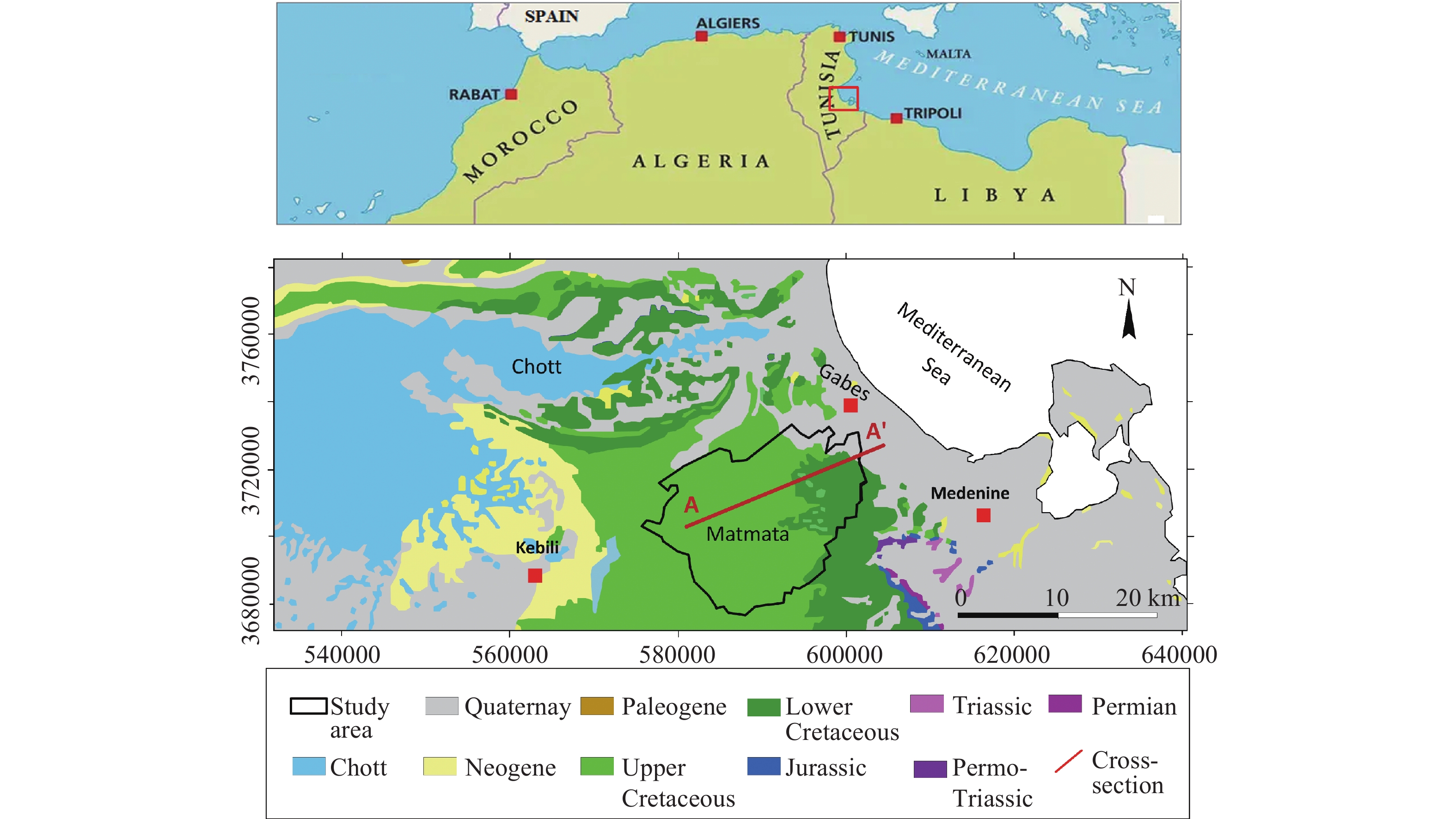
The Gabes aquifer system, located in southeastern Tunisia, is a crucial resource for supporting local socio-economic activities. Due to its dual porosity structure, is particularly vulnerable to pollution. This study aims to develop a hybrid model that combines the Fracture Aquifer Index (FAI) with the conventional GOD (Groundwater occurrence, Overall lithology, Depth to water table) method, to assess groundwater vulnerability in fractured aquifer. To develop the hybrid model, the classical GOD method was integrated with FAI to produce a single composite index. Each parameter within both GOD and FAI was scored, and a final index was calculated to delineate vulnerable areas. The results show that the study area can be classified into four vulnerability levels: Very low, low, moderate, and high, indicating that approximately 8% of the area exhibits very low vulnerability, 29% has low vulnerability, 25% falls into the moderate category, and 38% is considered highly vulnerable. The FAI-GOD model further incorporates fracture network characteristics. This refinement reduces the classification to three vulnerability classes: Low, medium, and high. The outcomes demonstrate that 46% of the area is highly vulnerable due to a dense concentration of fractures, while 17% represents an intermediate zone characterized by either shallow or deeper fractures. In contrast, 37% corresponds to areas with lightly fractured rock, where the impact on vulnerability is minimal. Multivariate statistical analysis was employed using Principal Components Analysis (PCA) and Hierarchical Cluster Analysis (HCA) on 24 samples across six variables. The first three components account for over 76% of the total variance, reinforcing the significance of fracture dynamics in classifying vulnerability levels. The FAI-GOD model removes the very-low-vulnerability class and expands the spatial extent of low- and high-vulnerability zones, reflecting the dominant influence of fracture networks on aquifer sensitivity. While both indices use a five-class system, FAI-GOD redistributes vulnerability by eliminating very-low-vulnerability areas and amplifying low/high categories, highlighting the critical role of fractures. A strong correlation (R2 = 0.94) between the GOD and FAI-GOD indices, demonstrated through second-order polynomial regression, confirms the robustness of the FAI-GOD model in accurately predicting vulnerability to pollution. This model provides a useful framework for assessing the vulnerability of complex aquifers and serves as a decision-making tool for groundwater managers in similar areas.
Atoui M, Agoubi B. 2026. Vulnerability assessment in fractured aquifer using improved vulnerability index: Applied to Gabes aquifer, Southeastern Tunisia. Journal of Groundwater Science and Engineering, 14(1): 69-82. doi: 10.26599/JGSE.2026.9280073.
 E-mail alert
 Rss
Rss















 Online Submission
 Peer Review
 Office Work
 Editor-in-chief
 News
News Download
 Links
Links


